

In 2019, Saigon Co.op was losing market share as competitors continued to open stores and attract shoppers. The retailer needed to understand not only who its customers were, but also what influenced their choices and which shopper groups it was underserving.
Research conducted with Kantar helped Saigon Co.op identify underserved shopper groups and informed changes to its business model. Yet knowing which customers it was missing did not fully explain why they chose another retailer.

The same gap can appear in any business that relies on customer segments to explain buying decisions. Shopper segments can show a business where it is underrepresented and what customers value. What often remains unanswered is the context behind a choice. What influences a customer’s decision? Which circumstances lead them to consider an alternative, and what are they trying to accomplish?
JTBD starts there: with the circumstances behind a choice and the forces that drive or prevent customers from changing their behavior.
A Persona Can Describe a Buyer Without Explaining the Purchase
A persona might describe the target customer as a 32-year-old urban professional who is married, financially comfortable, digitally active, and interested in quality products. Every detail could be accurate. The profile still leaves one important question unanswered: what made this person buy now? That gap matters. Two people with similar incomes, ages, occupations, and locations can face different circumstances and make different choices.
JTBD does not require companies to stop using demographics. Demographics can still help define a market, size an audience, or identify channels. The problem starts when demographic similarity is used to explain behavior. Christensen and his coauthors argue that customer circumstances and the job a person is trying to accomplish can be more useful for understanding choice than buyer characteristics alone.
For a company working with Vietnam’s emerging middle class, this distinction becomes more important as consumption spreads beyond the largest cities. McKinsey found that the number of middle-class households in smaller cities and rural areas was growing at about 8% annually, compared with 5% in Hanoi and Ho Chi Minh City in its analysis. That does not mean customers in different regions share fixed behaviors. It means location, income, access, infrastructure, and life circumstances can change the context in which a job emerges. Those differences should be investigated rather than treated as broad generalizations.
The more useful question is not simply “Who is our middle-class customer?” It is “What are they trying to get done when they choose a solution like ours?” That shift changes the research brief. Instead of collecting more demographic details, the team looks for moments of struggle, desired progress, alternatives considered, reasons for hesitation, and the solution they ultimately choose.
A Growing Middle Class Is Not One Customer Segment
Vietnam’s expanding consumer class creates a stronger commercial opportunity, but the market should not be treated as one uniform group.
The World Bank’s Vietnam Poverty and Equity Assessment (2022) reported that Vietnam’s middle class had grown from 7.3 million people in 2010 to 22.6 million in 2020. Separately, McKinsey’s 2021 research defined the “consuming class” by a spending threshold of at least $11 per day in purchasing power parity (PPP) terms. The study projected that this group could account for nearly 75% of Vietnam’s population by 2030. Consumer growth is also extending beyond Hanoi and Ho Chi Minh City, reshaping opportunities in smaller cities and urbanizing rural areas.
Together, these figures point to changes in Vietnam’s consumer market, but they do not establish that the middle class shares the same needs, values the same benefits, or follows the same buying behaviors. A company that converts the category “middle class” directly into a persona may still miss the circumstances that actually trigger purchase.
Three Jobs to Test in Vietnam’s Consumer Market
This is where a JTBD Matrix can make the research more specific. The matrix should connect a proposed job to the situation that creates it, the progress the customer wants, the functional outcome, the emotional or social dimension, the current workaround, and the forces that make switching difficult. It should also record the evidence supporting each assumption. A job without behavioral evidence is still a hypothesis, no matter how convincing it sounds in a strategy meeting.
For Vietnam, three jobs can be useful starting hypotheses for research. They should not be presented as universal characteristics of the middle class. They are testable propositions that can help a company decide whom to interview, what behavior to investigate, and which offers deserve further development.
The first hypothesis is financial security. A young professional couple in Ho Chi Minh City may have more income than before, yet face a growing number of decisions about housing, savings, insurance, and investments. The opportunity is not necessarily to offer another financial product. It may lie in helping them make decisions without feeling that every choice creates a new risk. Research needs to establish whether this tension recurs, what people do to manage it, and which conditions would make them trust a different solution.
The second hypothesis is daily-life efficiency. A time-poor manager may want shopping to take less time. But speed alone may not solve the problem if the process still requires too many decisions, comparisons, or coordination with other people. The job could be reducing the effort involved in getting everyday tasks done. Interviews should uncover where that effort accumulates and which parts customers would actually pay to remove.
The third hypothesis is quiet personal identity. Some consumers with greater purchasing power may want products that communicate taste without relying on conspicuous status signals. The job could involve choosing products that feel personally appropriate, durable, and distinctive while avoiding an overt display of wealth. Again, this should be tested through observed choices, language, purchase criteria, and switching behavior. It should not be treated as a general description of affluent Vietnamese consumers.
Why Customers Move Toward a Solution or Stay Where They Are
Identifying a job is only the beginning. Customers may recognize a problem and still stick with an imperfect solution because changing feels difficult. The 4 Forces of Progress help explain this tension through four forces: the push of the current situation, the pull of the new solution, the anxiety associated with the new solution, and the habit of the present.
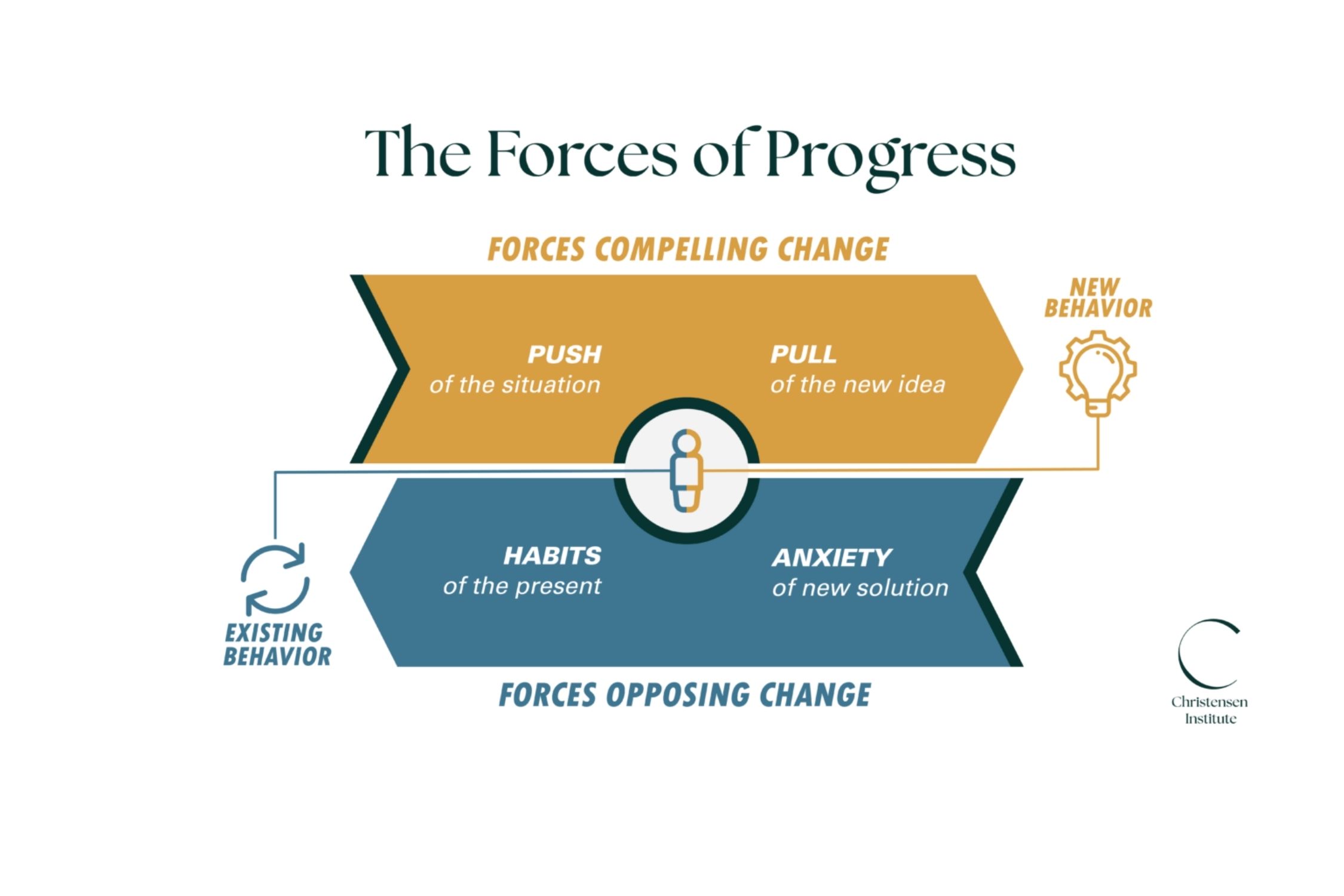
The first two forces move a customer toward change. The push comes from dissatisfaction or a struggling moment in the current situation. The pull comes from the perceived value of the new solution. The other two forces resist change. Existing habits make the current solution familiar. Anxiety creates uncertainty about whether the new option will work, cost too much, require too much effort, or introduce another problem.
This model changes how a company evaluates its offer. A financial service may have a stronger feature set, but customers may still hesitate if they do not understand the risk or feel uncertain about changing their existing process.
A retail proposition may promise faster shopping, but customers may continue using a familiar store because they already know where products are located and trust the current routine. The practical implication is straightforward: research needs to examine both the reasons to change and the reasons to stay.
Asking “What would make you choose this?” captures only part of the decision. A stronger interview asks what happened before the decision, what the customer considered, what they disliked about the existing option, what attracted them to the alternative, what made them hesitate, and what finally made them act. These answers enable companies to differentiate what customers say they want from what actually dictates their actions.
Importantly, the 4 Forces do not establish that anxiety or habit explains every marketing problem. Their value is in providing a structure for investigating those forces in real decision-making situations. The Christensen Institute also emphasizes the importance of understanding the circumstances and forces behind a choice, rather than relying only on buyer characteristics.
Saigon Co.op: From Shopper Behavior to Business Decisions
Saigon Co.op faced declining market share as competitors continued to open new stores and attract more shoppers. In 2019, Saigon Co.op worked with Kantar to understand changing shopper needs and identify growth opportunities. Kantar combined household purchase data in Vietnam with shopper demographics, purchasing behavior, and attitudes. The research identified three key drivers of retailer choice: price, convenience, and product range.
Kantar then grouped shoppers into six segments, including Premium shoppers, Convenience seekers, and Value seekers. The analysis showed that Saigon Co.op was underrepresented among premium shoppers in Ho Chi Minh City and convenience seekers in Hanoi.

Saigon Co.op then adjusted its business model based on these findings. The retailer launched Finelife to serve higher-income shoppers, opened eight mini-mart stores in Hanoi to reach convenience seekers, and developed an internal guidebook to help its network communicate more consistently with target shoppers. Kantar projected that these changes could generate an additional US$17 million in first-year revenue.
The case shows how behavioral data can reveal differences that a broad customer persona may miss. However, Kantar’s shopper segments are not Jobs-to-Be-Done in the strict sense. The research shows what shoppers value, but does not fully explain what they are trying to accomplish in a specific situation.
JTBD can take the research one step further. For convenience seekers, a company would need to understand whether they are trying to save time, reduce effort, simplify decisions, or solve a specific shopping situation. That is the shift from segmenting customers to identifying the jobs that actually drive their buying decisions.
Build the JTBD Matrix Around Evidence, Not Assumptions
A useful JTBD Matrix should make uncertainty visible. For each proposed job, the team can record the customer situation, trigger, desired progress, functional outcome, emotional or social dimension, current solution, competing alternatives, push, pull, anxiety, habit, evidence, and next research question. This structure prevents the team from treating a well-written persona as proof that a job exists.
- Situation: “A young household has increased its income but struggles to coordinate savings, insurance, and daily spending.”
- Job: Make financial decisions with greater clarity and control.
- Current workaround: Use separate bank accounts, spreadsheets, or informal advice.
- Barrier: Concern about fees, reliability, and the effort required to move existing arrangements.
- Evidence needed: Interviews and observed behavior showing recurring coordination problems, current workarounds, and specific reasons for hesitation.
- Experiment: Test a simplified financial-planning service with a small group of qualified users and measure activation, repeat use, and willingness to pay before considering wider investment.
The same logic applies to daily-life efficiency. If customers claim that they want convenience, the team should ask what “convenience” means in the specific circumstance. Does it mean fewer trips, fewer decisions, faster delivery, easier comparison, simpler payment, or less coordination with other people? These distinctions can lead to different products, propositions, channels, and messages.
- Advance: The job has enough behavioral evidence to justify deeper validation.
- Hold: The hypothesis is plausible, but the evidence is incomplete.
- Stop: Research has not found sufficient evidence, or the job does not appear strong enough to guide investment.
That makes the matrix a working decision tool, not just another strategy slide. It also gives leadership a clearer answer to the question “What jobs matter for growth?” The answer should not be a list of attractive customer needs. It should be a small number of jobs supported by evidence, linked to specific circumstances, and strong enough to justify a business test.
From Persona Theater to Three Jobs Worth Validating
JTBD does not require companies to abandon personas. It asks them to stop treating a persona as the final explanation for customer behavior.
A persona can help a team decide where to look. A job helps it decide what to investigate once it reaches that audience. This distinction matters as Vietnam’s market becomes more diverse in income, location, household structure, and consumption context.
For Vietnam’s emerging middle class, the immediate task is modest: identify three jobs worth validating. Financial security, daily-life efficiency, and quiet personal identity are starting hypotheses, not established traits of the entire group.
Research needs to establish which jobs recur, what situations trigger them, which alternatives customers already use, and what makes them hesitate to switch. The goal is not a larger library of personas. It is a clearer model for making decisions. A company needs to know which circumstances create an opportunity, what progress the customer wants, which existing solutions already meet part of that need, what makes change difficult, and what must be proven before investment.
That is where JTBD becomes useful to Brand-to-Market work. It does not replace positioning, brand strategy, product design, or commercial analysis. It gives those decisions a behavioral evidence base by connecting an offer to a real situation and an observable choice.
No single job explains Vietnam’s middle class. The task is to find enough evidence to decide which jobs deserve attention, which assumptions should be dropped, and which offers merit a business test. That gives a company a stronger basis for deciding what to build, what to communicate, and what to validate next.