

The Vietnamese market operates on a fundamentally different temporal rhythm from Western commercial markets. Yet many multinational F&B and retail companies continue to treat Lunar New Year as simply the “Vietnamese version of Christmas.” This is not a harmless simplification, but a strategic misreading that can carry serious long-term consequences for brand equity.
In Europe or North America, Christmas functions primarily as a peak retail season, centered on gifting and standardized rituals of decoration and promotion. In contrast, for Vietnamese consumers, Tết is not merely a consumption event. It is a period of social and emotional rebalancing, a time when family bonds, ancestral responsibility, and spiritual continuity take precedence over transactional behavior.
As a result, Vietnamese consumers evaluate brand actions and messaging during Tết with exceptional scrutiny. They assess whether a brand demonstrates genuine cultural understanding and respect, or whether it is merely exploiting a festive moment as another sales-driven campaign.
Why “Turning Everything Red” Fails as a Tết Branding Strategy
As Lunar New Year approaches, many brands instinctively switch their logos to red or add festive decorative elements. In practice, however, this is not brand building. It is a short-term attempt to capture attention. When every brand follows the seasonal visual noise, yours is easily absorbed into the seasonal noise, with little that remains distinctive amid the sea of red.

There is a persistent assumption that Vietnamese consumers care only about eye-catching visuals and promotional discounts. In reality, Tết is one of the most culturally significant moments of the year. Consumers evaluate closely whether a brand truly understands the occasion and contributes something meaningful to their lives. When companies fail to distinguish between a temporary sales campaign and long-term brand strategy, strategic errors become almost inevitable. A brand’s differentiated values are quickly drowned out by a market saturated with near-identical “redwashed” messages.
To break out of this pattern, brands must rethink their Tết communication strategy. The focus should shift toward building a strong brand identity grounded in trust and in the brand’s authentic cultural role. This is what enables lasting memory and build long-term customer loyalty rather than fleeting sales spikes that disappear as quickly as they arrive.
The “Red Ocean” Fallacy: Following the Crowd During Tết
Many brands define their early-year commercial objectives almost entirely around the use of red and gold palettes and aggressive discounting. The prevailing logic is simple: if competitors are doing it, we must do the same to remain market relevant. This is a fundamental strategic error.
When a company adopts the same visual language and promotional mechanics as every competitor, its brand becomes effectively invisible amid thousands of similar advertising messages. For premium players in retail and food service, this is particularly damaging. Brands incur high media costs, yet leave no lasting imprint in the consumer’s mind.
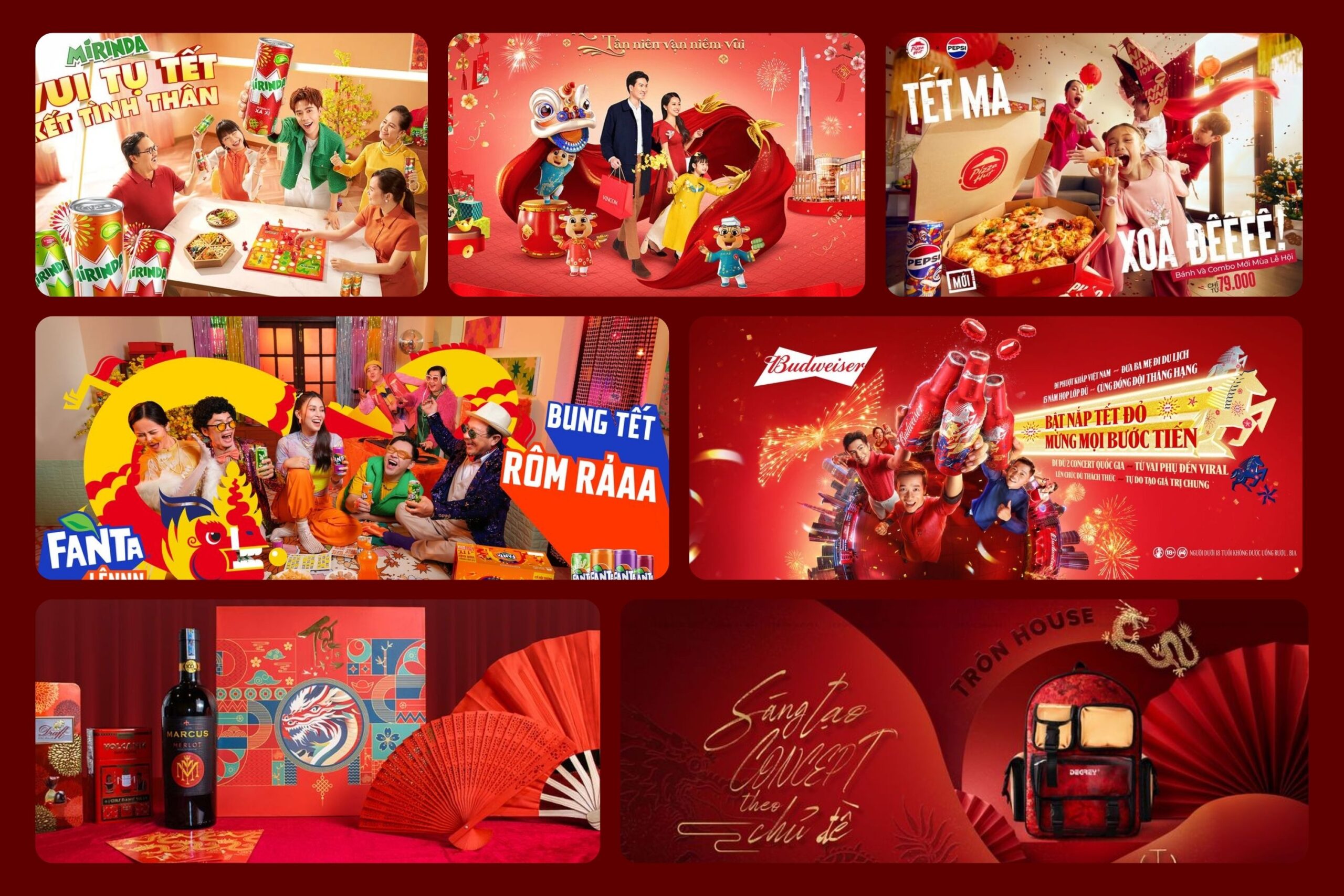
The real issue is not the use of red itself, but the absence of a defensible reason for using it. When a brand fails to connect its core brand identity with the distinctive emotional meaning of Tết, the campaign remains superficial and signals a lack of cultural understanding.
Contemporary Vietnamese consumers, especially those in the upper-middle-income segment, increasingly seek brands with sophistication and depth. They expect respect for tradition, but in a form that resonates with modern life. A campaign built solely on red visuals and price promotions will fail, because it overlooks deeper customer needs for status, cultural values, and emotional connection, the very elements that define an authentic Tết experience.
Four Strategic Pillars of an Effective Tết Campaign
To create distinctive and effective Tết campaigns, brands must evaluate their strategy through four critical dimensions: Theme, Emotion, Timing, and Call to Action (CTA). These are the strategic levers that determine whether a campaign merely gains attention or genuinely drives meaningful engagement and conversion.
Theme
This is the most decisive element. A brand must anchor its core identity to a specific cultural insight of Lunar New Year. Rather than relying on generic motifs such as reunion, brands should explore deeper narratives. This may include the intersection between tradition and modern life, or the quiet, often invisible efforts that come together to create a complete Tết experience. This aligns with best-practice frameworks in brand strategy development that tie core identity to cultural insight.
Emotion
Brands should avoid formulaic attempts to manufacture joy or humor, as commonly seen in mass-market campaigns. Instead, they must define the precise emotional response they seek to evoke and design the campaign accordingly. This may include the relief of returning home, the pride of caring for one’s family, or a rare moment of stillness for self-reflection. When the target emotion is clearly articulated, brands can achieve far deeper resonance with consumers.
Timing
Messaging must be calibrated to the three critical phases of Tết: year-end preparation (Tất niên), the moment of transition (New Year’s Eve), and the early days of the new year (Tân niên). Without adaptive content across these stages, it becomes difficult for a brand to sustain relevance and continuity throughout the season.
Call to Action (CTA)
Finally, the CTA should emphasize intrinsic brand value rather than relying solely on price promotions to stimulate short-term demand. Brands must position themselves as an integral part of Tết rituals and practices. This enables consumers to perceive the product or service not as optional, but as essential to their early-year experience.
F&B Tết Vietnam: From Short-Term Discounting to Long-Term Brand Equity
An analysis of successful Tết campaigns reveals a consistent pattern: winning brands prioritize real value over tactical sales activation. In Vietnam’s food and beverage sector, the contrast is especially clear.
Unsuccessful campaigns typically depend on aggressive discounting to generate short-term volume. While effective in driving immediate sales, this approach gradually erodes long-term brand credibility. In contrast, brands that leverage the cultural logic of gifting create a far more complete experience, because consumers care as much about packaging, narrative, and emotional meaning as they do about the product itself. This is how an ordinary product is transformed into a distinctive gifting experience. The result is deeper emotional connection and stronger long-term brand memory.
In retail, many brands fall into the trap of placing “luck” at the center of their Tết narrative. While luck is undeniably part of the cultural vocabulary of the holiday, many campaigns reduce it to a game of chance rather than expressing the effort, care, and authentic value that consumers truly aspire to. A more sophisticated strategy positions the brand as a companion in personal renewal, helping consumers move toward a better version of themselves in the new year. This requires a nuanced understanding of consumer psychology, as individuals balance year-end pressure with hope for a meaningful fresh start.
At this point, the brand is no longer merely selling products. It is offering reassurance, refinement, and emotional stability amid the intensity of the festive season.
Coca-Cola 2026: When Technology Weaves a New Brand Identity
In a Vietnamese F&B market saturated with conventional “reunion” narratives, Coca-Cola’s 2026 campaign, “Ignite the Spark, Weave a New Tết,” represented a deliberate strategic departure. By applying artificial intelligence to reinterpret traditional cultural values, the brand moved beyond conventional advertising toward the creation of an emotional connection with a younger generation of consumers. This was not merely a creative execution. It was a brand intervention designed to modernize heritage without diluting its meaning.
The Imperative of Self-Renewal
Coca-Cola confronted the defining challenge of any legacy brand: how to sustain relevance without becoming dated. Rather than relying solely on its signature red, a visual code long embedded in consumer memory, the brand refreshed its expression through Vietnamese folk materials and traditional art forms such as Hàng Trống paintings and lion dance, reimagined and “woven” through AI technology.
By reconstructing familiar cultural elements through a new technological medium, Coca-Cola avoided repetition while signaling renewal without abandoning continuity. This approach modernized heritage without diluting meaning, aligning with broader discussions on brand renewal versus rebranding.

The use of AI-generated short films demonstrates Coca-Cola’s deep understanding of Gen Z and Gen Alpha lifestyles. The brand does not speak about tradition in a conventional voice. Instead, it uses the language of the future to preserve the values of the past. This approach clearly differentiates Coca-Cola from competitors who continue to rely on predictable imagery of year-end family meals.
From Product to Cultural Symbol
By reconstructing folk art through AI technology, Coca-Cola elevated the can from a functional beverage into an integral part of Tết culture. Consumers did not choose the product because it was red. They chose it because the brand came to represent the spirit of a modern Tết, one that honors core values while continuously reinventing itself. This is how a brand builds real mental and cultural value in the consumer’s mind, rather than remaining a random option on a supermarket shelf.
Creating Emotional Imprint and Multisensory Experience
A deeper analysis of the emotional dimension shows how the campaign activated what can be described as multi-layered resonance. Instead of focusing solely on reunion and happiness, Coca-Cola tapped into pride and wonder, the emotion of seeing Vietnamese culture reinterpreted through a new technological lens.
The combination of familiar folk music with fluid, AI-generated motion created a powerful affective response. This renewal allowed the brand to associate freshness, vitality, and hope for a peaceful new year with its identity. More importantly, by delivering a differentiated and memorable experience, Coca-Cola avoided price-based competition. Profitability was protected because value resided in experience, not in undercutting competitors on price.
The Consequences of Formulaic Tết Marketing
When a company fails to invest in a sufficiently rigorous Tết strategy, a structural distance gradually emerges between the brand and its customers. By merely replicating familiar market templates, the brand begins to erode its own core identity and fades into the competitive background. Missing revenue targets during the Tết season is not, in fact, the greatest risk. The more serious danger is that consumers come to remember the brand only through discounts and promotions. When purchase decisions are driven solely by low prices or short-term incentives, brand loyalty disappears.
Superficial and poorly directed Tết campaigns further weaken a company’s core values over time. When brands repeatedly deploy advertising indistinguishable from their competitors, differentiation collapses. After three to five years, the market begins to perceive the brand as generic and undifferentiated. At that point, lower-priced competitors can easily displace the brand’s position in the market.
In Vietnam, Tết is the single most critical period of the year for building brand image. Squandering this moment on repetitive and uninspired campaigns is a strategic marketing failure, one that directly undermines long-term brand growth and future competitiveness.
Establishing Brand Position During the New Year Transition
Lunar New Year is the decisive moment that determines whether a brand will be remembered or forgotten in the minds of Vietnamese consumers. To achieve meaningful impact, companies must look beyond surface-level advertising and price promotions. The starting point is a deep understanding and genuine respect for the cultural values embedded in Tết.
Successful campaigns require serious investment in consumer research, coherent brand expression, and the abandonment of outdated marketing methods that no longer deliver results. When a campaign is built around real lived experiences, family reunion, year-end pressure, and the emotional weight of transition, the brand gains clear separation from competitors. Brand credibility is not created through loud or excessive advertising. Trust is earned when a brand appears at the right moment and addresses the right need during critical life periods. For this reason, leadership teams must define clear strategic objectives before each Tết season.
Rather than focusing narrowly on color palettes or visual decoration, brands should ask a more fundamental question: What real value does the brand bring to consumers at the moment of year-end transition?